
Making Their Bubbie’s Testimony Their Own and a Mitzvah Project to Remember
Interview with Liz Lieberman about Her Children’s B’nai Mitzvah Project
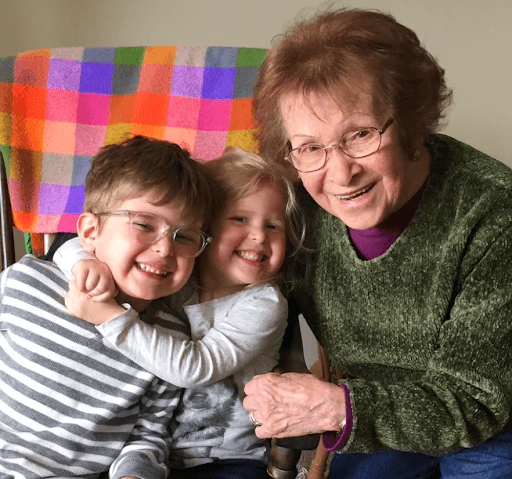
Last fall, Liz’s children decided to focus their b’nai mitzvah project on researching and writing, in their own words, their Bubbie’s extraordinary story of survival and bravery. Liz’s grandmother, Lilly/Leah Binstock, was a Holocaust survivor. The following interview with Liz shares her family’s personal and touching experience through this project.
How did you get the idea to work with your family’s Holocaust experience as part of this b’nai mitzvah?
During a family trip to Washington, DC, we visited the U.S. Holocaust Memorial Museum and spent time in the Library and Archives Reading Room researching my grandmother, Bubbie. We discovered interviews and documents that revealed her extraordinary story of survival and bravery. Later, we watched her 1996 testimony for the USC Shoah Foundation, founded by Steven Spielberg, to give survivors a voice. Hearing her speak so directly moved our whole family deeply.
For their mitzvah project, Max and Emma retold Bubbie’s story in their own words. Growing up, my Jewish identity was shaped more by culture and family than formal religious practice. It centered on traditions, family gatherings, and honoring what my grandmother and her sister endured so that future generations could be here today.
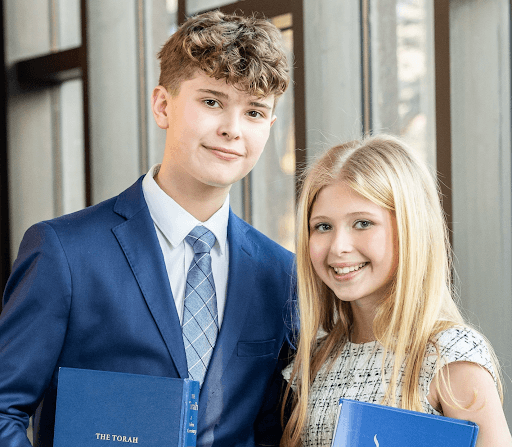
We’ll always remember hearing Bubbie’s story in depth for the first time. — Max & Emma
We wanted the project to reflect both sides of their heritage, blending my cultural Jewish roots with my husband’s more religious, though still Reform, background. Focusing on family history and legacy felt especially meaningful. With the rise in antisemitism since October 7th, the kids also felt a responsibility to share their Bubbie’s story in a way that could reach people of all ages. That sense of purpose gave their project its heart and direction.
What did your children get out of their b’nai mitzvah project?
They gained a much deeper understanding of struggle and resilience. My grandmother passed away when they were pretty young, so they never had the chance to hear her story firsthand. Watching her recorded interview made the fact that their great grandmother was a Holocaust survivor feel real and personal, not like distant history. They truly grasped that they are here because of what their Bubbie endured.
The project sparked a real curiosity about history and an awareness of how easily it can echo into the present. While they are still too young to fully process the scale of both past and recent atrocities, they developed a stronger pride in their Judaism and a thoughtful concern about the world around them. It also helped them feel more connected to the cultural Jewish identity that shaped my own upbringing.
What was the hardest part of the project?
Deciding when and how to let Max and Emma fully hear my grandmother’s story was one of the hardest parts. Parts of her story are heartbreaking and scary, and while my children are very mature, they are still children.
There were practical challenges as well. We worked from a recorded interview that wandered at times due to language barriers and spontaneous questions. Building a clear, accurate timeline took care and follow-up with my uncle to verify details. Editing the story down was surprisingly difficult. Leaving out pieces felt uncomfortable because every part of what she survived matters.
What stayed with us most was not being able to ask my grandmother follow-up questions. The kids felt that loss personally, and it deepened their commitment to preserving and sharing her story. Balancing the project with school, sports, and b’nai mitzvah preparations was a stretch, but made the finished work feel even more meaningful.
Was any part of the project unexpectedly easy?
Sharing the project with family and friends was effortless in the best way. People were eager to listen, learn, and support the kids. Max and Emma felt a real sense of pride and connection when they saw how strongly others responded to their Bubbie’s story.
What was it like for you to see your own children take on the work of preserving your family’s Holocaust experience?
It was very moving. This was new for me too. I had never formally worked through or shared my grandmother’s full history, and in many ways we learned it together as a family. Walking through the story step by step had a real impact on all of us.
I felt incredibly proud of how thoughtfully and respectfully they handled the material. They didn’t just complete a project. They embraced her story as part of their own identity and felt a real responsibility to carry it forward.
Did any part of this experience touch you deeply?
Watching Max and Emma hear their Bubbie’s story for the first time and truly absorb it was one of the most touching parts of this experience. Seeing the moment when history became real and personal for them was very powerful. We were struck by their curiosity, their empathy, and the way they carried the weight of her experiences with such care and respect.
It also touched us to see how the story brought our family together in a new way. The combination of connection, learning, and the responsibility they felt to honor her legacy made the experience profoundly emotional for all of us.
Did the project benefit you or your family?
Learning my grandmother’s story together created conversations and moments of reflection that we hadn’t had before. It strengthened the kids’ sense of identity and connection to their Jewish heritage, and it helped me see my own family history with fresh perspective and deeper appreciation.
It gave all of us a shared purpose. Working together to preserve and share Bubbie’s story reminded us how important it is to remember and honor the past, and it inspired a greater awareness of resilience, empathy, and responsibility in our everyday lives.
What do you think your children will remember from their b’nai mitzvah project years from now?
The personal connection they formed with Bubbie’s story. Experiencing her journey firsthand, even through the recorded interview, made history tangible and deeply meaningful. They’ll remember the pride and responsibility they felt in carrying her story forward, and the sense that they’re part of something larger than themselves.
A key learning moment was realizing how much resilience and courage it took for their great grandmother to survive and rebuild her life. They learned the importance of preserving family history and sharing it with others, and how doing so can connect people across generations. Those lessons about empathy, identity, and responsibility will likely stay with them long after the b’nai mitzvah itself.
Do you have any advice or suggestions for families whose children may be considering a similar b’nai mitzvah project?
If your family has a recorded interview or any firsthand accounts, start there and watch it together with your children. These recordings bring history to life in a way that nothing else can. Reach out to the researchers at the U.S. Holocaust Museum or similar archives. They have access to documents and resources that are not available in the public databases, and these materials can add incredible depth and context.
Turning the interviews into short narratives can make them easier to share and help ensure that these important stories reach more people.
What would your grandparents think of your children taking on this project for their b’nai mitzvah?
My grandmother loved my kids so much. I know she would have been very touched that Max and Emma chose to honor her with this project. She was always so humble about her experiences, and it took her a long time to fully realize how incredible her survival was. I think she would have been proud to share her story with them and to see them take it on with such care and respect.
Our family and friends were really impressed by how thoughtfully the kids approached the project and by the final result. More than that, I think everyone could see how meaningful it was for the children to connect with their history, understand the resilience of the generation before them, and feel the responsibility to keep that legacy alive. It brought our family closer and made all of us reflect on the importance of remembering and sharing these stories.
Interview with the Max and Emma about Their B’nai Mitzvah Project
What part of your mitzvah project did you enjoy the most?
We enjoyed learning about Bubbie’s life and discovering where we came from. She was around our age when the war started, which gave us a really interesting perspective. Watching her interview felt almost like she was talking about a movie. It was full of suspense and at times almost like an adventure, that seemed too unbelievable to be real. At the same time, it made history we had only heard about feel personal and helped us understand the courage and grit it took for her to survive.
What part of your mitzvah project are you most proud of?
Being able to share Bubbie’s story as fourth-generation survivors is what we’re most proud of. It felt really special to take something so important from our family and help other people understand it. We’re proud knowing that her story moved people and made them think about what she went through. Doing this project made us feel closer to Bubbie.
What was the most difficult or challenging part?
Hearing what Bubbie went through and realizing all the struggles she faced so that we could have the life we have today was the most difficult part. Some parts of her story were really hard to listen to, and it made us think a lot about how scared she must have been. It was also really tough not being able to ask her more questions or hear her answers to the things we were curious about. We missed her a lot in those moments.
What do you think you’ll always remember about your mitzvah project?
We’ll always remember hearing Bubbie’s story in depth for the first time. It changed the way we see our family and our Judaism. It made us proud and want to make sure her story gets told. It also made us want to stand up to ignorance and antisemitism and do what’s right. Learning about everything she went through helps us keep things in perspective and appreciate how easy our lives are compared to hers. We were only five and six when she passed away, so getting to hear her story like this made us feel closer to her and will help us remember her forever.
What will you always remember about your Bubbie that you might share with your friends, or would you consider life-long advice?
Our Bubbie used to tell us to be happy no matter what. Our mom would remind us how amazing that is coming from someone who had lived through such terrible things. It taught us to appreciate everything we have, try to not take anything for granted, and try to always see the good in life.
What would you share with someone who is considering doing a similar mitzvah project?
Really listen and try to understand what your family member went through. Take your time with the story and let it sink in. It will help you connect with your family, your history, and your Judaism in a way that will stay with you.
We’ll teach you how to share your grandparent’s story.