
The Story of My Abuela “Tati” Rebeca / Riva Faidengold Zabner
By Rashell Allswang, 3G Chicago
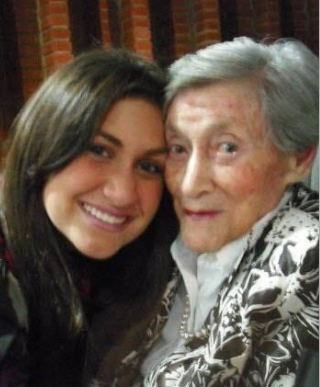
Both of my maternal grandparents survived the Holocaust. My grandfather died brought on by before my mother was born, but my grandmother was in my life until she passed away during my senior year of high school
I’ve always liked public speaking, but when I was pregnant with my second daughter, I had a dream about my grandma. I took it as a sign. I decided to name my daughter after her. This was right around the time of October 7th, so there were a lot of swirling emotions and questions — about identity, about responsibility as a 3G. That dream and that moment were huge motivators for me.
October 7th is the closest thing we’ve experienced that compares to the Holocaust. Being a 3G makes me unable to be naive. My threshold of tolerance for hate against me and against Jews is low. I quickly lost faith in humanity. I’m an optimist at heart, but with everything going on, it became clear that hate is real. The only difference between me and my grandmother is that she was born in 1926 and I was born in 1994.
When I joined the leadership at the Illinois Holocaust Museum, I found out about 3G Chicago. I became part of the initial founding committee of 3GChi. I want 3G to be something I’m known for, it drives my passion.
I’m Modern Orthodox, and I found that a lot of the people involved in 3G aren’t very observant, so it’s important to me to give a voice and a face to 3G groups in the Orthodox community. I want to show my community that this group exists and brings awareness to the Holocaust and to continuing antisemitism. It’s relevant to the Orthodox community, and I’d like to bridge that gap with my story.
3G Speaker training was a turning point for me. At the last class, I got super emotional. Everyone had such different stories and levels of trauma, and it was unbelievable. It really felt like: we have each other. We don’t need to explain. We’re bonded.
No one in my generation has told my grandmother’s story yet, and I feel like it’s my responsibility. My aunt inspired me to start doing speaker training because she started the push to research and tell my grandfather’s story — even though he died before my mom was born. That inspired me to step up, too.
My grandma would be proud and happy that we’re continuing to share her story. She’d also be really happy to know we’re recognizing my grandfather’s story. She’d probably be a little sad that we have to have these conversations as a means of education — to almost prove that this happened.
I want to give people a human connection to the Holocaust, to the number six million and the maps. I want kids to be able to say, “I met someone who…” when they talk about the Holocaust.
My grandma was in labor camps in the Ukraine–Romania area. Her parents were in the ghetto, but didn’t go through any labor. After liberation, they found her through a messenger and were reunited. They went back to their hometown and stayed there for two years, working and saving money so they could escape to Paris which was neutral territory. Eventually, they found out her two older siblings were in Venezuela and had made an appeal to find them, so they decided to go to Venezuela.
My grandfather told her to go to Palestine, now Israel, but she wouldn’t leave her family.
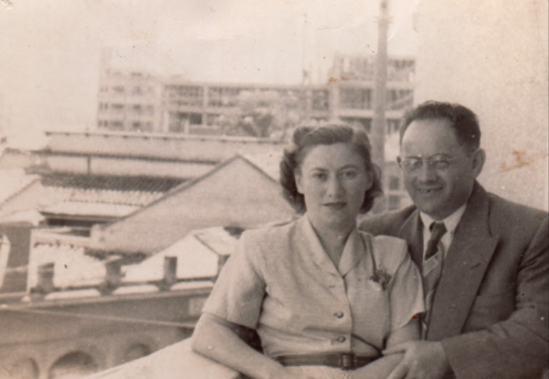
On my dad’s side, we’re Sephardic. My great-grandparents lived in Jerusalem in the 1920s, but there were Arab pogroms, and my great-grandfather got hit in the head with a rock. He had two young kids and decided they needed to leave. Both sides of my family were just fighting for their lives. It’s all resilience and Jewish pride.
My mom is an example of living with resilience as well. She didn’t grow up with a father; he died because of what he went through in the Holocaust. Lung cancer from the chemicals he was exposed to in his job. But my grandma, despite all the pain she went through, instilled in my mom, and in me, an appreciation for life. She taught us to work hard, be a good person, and that your name carries you everywhere. I’m really proud to have these stories and to have them be a part of my identity. I want my kids to also feel compelled and proud to say: I’m part of this chain of survivors. I want to instill more pride in our Judaism that will be carried on.
I’m proud I found this opportunity and excited to see what impact I can make. It’s very empowering, and I hope other people can find their voice and feel that sense of ownership to carry it on.
We’ll teach you how to share your grandparent’s story.